by Ariful | May 23, 2026 | UK Updates
Navigating the tax landscape when you are trading cross-border can feel like trying to solve a puzzle with pieces from two different boxes. If you are running a UK Limited Company and selling into the Australian market, or operating a subsidiary Down Under, 2026 is bringing significant shifts you cannot afford to ignore. From the implementation of global minimum tax rules to changes in how you handle employee superannuation, the Australian Taxation Office (ATO) is tightening its grip on compliance.
Don’t worry; we have distilled the most critical updates into this quick-read guide. Whether you are an e-commerce brand, a digital service provider, or a growing SME, here is what you need to know to stay compliant and protect your margins.
Prepare for the Global Minimum Tax (Pillar Two)
The biggest headline for 2026 is Australia’s full commitment to the OECD Pillar Two framework. Starting from 1 July 2026, Australia is integrating rules that establish a 15% global minimum tax rate. While this primarily targets large multinational groups with global revenues exceeding €750 million, its "trickle-down" effect on compliance and reporting is substantial for all international entities.
If your UK Limited Company has an Australian presence, be it a branch or a subsidiary, you must monitor your Effective Tax Rate (ETR). If your local incentives or depreciation rules pull your Australian ETR below 15%, you could face a "top-up tax." This ensures that regardless of where your profits are booked, you are paying at least the global minimum. We recommend reviewing your intercompany pricing and debt levels now to avoid any unexpected tax hits in both the UK and Australia.
Boost Your Cash Flow with the Reintroduced Loss Carry-Back
There is good news for UK companies investing heavily in their Australian expansion. From the income year commencing 1 July 2026, the Australian government is reintroducing the company loss carry-back regime.
This is a powerful tool for your cash flow. If your Australian operations incur a tax loss, you can "carry back" those losses to offset tax you paid in the previous two years. Instead of waiting years to use those losses against future profits, you can claim a cash refund now. For eligible companies with an aggregated global turnover of less than AUD 1 billion, this provides a vital safety net during periods of high capital expenditure or market volatility.
Master the New "Payday Super" Requirements
If you employ staff in Australia or have a local team supporting your digital brand, your payroll processes are about to get a major update. From 1 July 2026, the ATO is introducing Payday Super.
Currently, many employers pay superannuation contributions on a quarterly basis. Under the new rules, you must pay your employees' superannuation at the same time you pay their wages. This change is designed to ensure employees receive their entitlements sooner and to give the ATO real-time visibility into compliance.
For a UK-based management team, this means your payroll systems must be robust. Late payments can result in heavy penalties and interest charges. It is essential to ensure your Australian bookkeeping is integrated with your payroll to handle these frequent disbursements without a hitch.
Secure Your Small Business Instant Asset Write-Off
If your Australian entity qualifies as a small business (generally those with a turnover under AUD 10 million), the AUD 20,000 instant asset write-off has been made permanent starting 1 July 2026.
This allows you to immediately deduct the full cost of eligible depreciating assets, such as computers, office equipment, or tools, costing less than AUD 20,000. For a growing digital agency or e-commerce business, this is a significant incentive to upgrade your local infrastructure while reducing your taxable income in the same year. Just remember: the asset must be first used or installed ready for use within the financial year you claim it.
Don't Forget the GST on Digital Services
While the core GST rate remains steady at 10%, the ATO has increased its focus on enforcement for non-resident suppliers. If your UK Limited Company sells digital services (like SaaS, apps, or streaming) or low-value goods (under AUD 1,000) to Australian consumers, you likely have GST obligations.
You must register for GST if your "Australian-connected" supplies exceed AUD 75,000 per year. Even if you don't have a physical office in Sydney or Melbourne, selling to Australian residents triggers these rules. We see many UK businesses overlook this, leading to backdated tax bills and penalties. Ensure your checkout systems are correctly identifying Australian customers and applying the 10% GST where necessary.
Review Your Thin Capitalisation and Interest Limits
Australia has moved to an EBITDA-based test for limiting interest deductions. This is particularly relevant if your UK parent company provides loans to your Australian subsidiary.
The goal of these rules is to prevent companies from shifting profits out of Australia through excessive interest payments. If your Australian entity is over-leveraged, the ATO may deny your interest deductions, effectively increasing your tax bill. In the context of the new Pillar Two rules, this could also impact your Effective Tax Rate. We suggest reviewing your intercompany financing agreements to ensure they align with these stricter EBITDA thresholds.
How Sterlinx Global Streamlines Your Australian Compliance
Managing tax in one country is hard enough; managing it across borders is a full-time job. At Sterlinx Global, we don’t just offer advice, we deliver compliance. We function as your Global Tax Compliance Suite, handling the heavy lifting so you can focus on scaling your business.
Our structured, tech-driven system is built for UK Limited Companies trading in Australia. We provide:
- Ongoing Bookkeeping: We keep your Australian accounts accurate and ready for reporting.
- GST Management: From registration to filing, we ensure you stay on the right side of the ATO.
- Corporate Tax Filings: We manage your year-end accounts and tax returns, ensuring you take advantage of regimes like the loss carry-back.
- Payroll & Payday Super: We ensure your Australian team is paid correctly and your superannuation obligations are met on time, every time.
Don't let changing regulations slow your international growth. By partnering with us, you gain a dedicated team that treats your compliance as a priority, not an afterthought.
Ready to simplify your Australian tax obligations? Talk to an expert at Sterlinx Global today and let us handle the paperwork while you build your brand.
Frequently Asked Questions (FAQ)
What is the GST registration threshold for UK companies selling in Australia?
You must register for Australian GST if your annual turnover from sales connected with Australia is AUD 75,000 or more. This includes sales of digital services and low-value goods to Australian consumers.
When does the new Payday Super rule take effect?
The Payday Super requirement, which mandates that superannuation be paid at the same time as wages, starts on 1 July 2026.
Can a UK company claim the Australian instant asset write-off?
Yes, if your Australian entity (subsidiary or branch) qualifies as a small business with an aggregated turnover of less than AUD 10 million, you can claim the AUD 20,000 instant asset write-off for eligible assets.
What is the corporate tax rate in Australia for 2026?
The base corporate tax rate for small to medium businesses (turnover under AUD 50 million) is generally 25%, while the standard rate for larger entities is 30%. However, with the Pillar Two implementation, a 15% global minimum effective tax rate also applies.
How does the loss carry-back regime help my business?
The loss carry-back regime allows companies to use current tax losses to offset tax paid in previous years, resulting in a cash refund from the ATO. This is particularly helpful for managing cash flow during expansion.

by Ariful | May 23, 2026 | USA Accounting
Scaling your business into the United States is a significant milestone for any international brand. Whether you are an e-commerce seller on Amazon, a SaaS provider, or a growing digital agency, the US market offers unparalleled reach. However, that growth comes with a complex web of compliance requirements that change almost daily.
In 2026, "Economic Nexus" has become the primary regulatory hurdle for non-US entities. Unlike traditional tax rules that required a physical office or warehouse, modern state tax laws trigger obligations based solely on your sales volume. If you aren't monitoring these thresholds daily, you could be accruing massive liabilities without even knowing it.
At Sterlinx Global, we focus on the operational execution of your tax compliance. We don't just tell you the rules; we manage the filings and data so you can focus on scaling. This guide breaks down why daily monitoring is your best defense against costly IRS and state tax pitfalls.
The 2026 Shift: Why Thresholds are Changing
State governments across the US are constantly refining their tax codes to capture revenue from remote and international sellers. For a long time, many states used a "200 transaction" rule as a trigger for sales tax registration. As of 2026, we are seeing a massive shift away from this model.
States like Illinois, Utah, and Kentucky have officially removed or are in the process of removing their transaction-count thresholds. Instead, they are moving toward a simplified, revenue-based model, typically $100,000 in gross sales. While this sounds simpler, it actually requires more precise tracking.
Why this matters for you:
- Illinois: As of January 1, 2026, you no longer need to worry about the 200-transaction count. If you hit $100,000 in retail sales in a 12-month period, you must register.
- Kentucky: Following suit in August 2026, the 200-transaction rule disappears, leaving only the $100,000 revenue trigger.
- Simplification is a trap: While you don't have to count every small order, missing that $100,000 mark by even a few dollars can lead to back-dated tax assessments and heavy penalties.
Understand Economic Nexus for International Sellers
If you are a non-US company (such as a UK Limited Company, a Canadian Corporation, or an Australian entity), you might think US state taxes don't apply to you. This is a dangerous misconception. Economic Nexus is about where your customers are, not where your business is registered.
Most US states do not offer "treaty protection" for sales tax. While a tax treaty might help with federal income tax, it does nothing to protect you from the Department of Revenue in California or New York. If your US-destination sales exceed a state’s threshold, you are legally required to:
- Register for a Sales Tax Permit in that state.
- Collect the correct tax rate from your customers at checkout.
- Remit (pay) that tax to the state on a monthly or quarterly basis.
Scaling without monitoring these numbers is like driving a car without a speedometer, you won't know you've broken the limit until you get the fine.
Avoid the "Marketplace Facilitator" Confusion
Many of our clients sell through platforms like Amazon, Etsy, or Walmart. These platforms are "Marketplace Facilitators," meaning they collect and remit sales tax on your behalf for sales made on their platform.
However, here is the pitfall: Marketplace sales still count toward your nexus threshold in most states.
Even if Amazon collects the tax, those sales could push you over the $100,000 limit in a state like Florida or Texas. If you then start selling through your own Shopify store or direct-to-consumer website, you are suddenly liable for tax on those direct sales. Without daily monitoring of your aggregate sales across all channels, you risk missing the registration deadline.
If you are struggling to reconcile your marketplace reports with your direct sales, Contact us to see how our structured compliance system can automate this tracking for you.
IRS Pitfalls vs. State Tax Obligations
While "Nexus" is a state-level issue, the IRS manages federal obligations. For international sellers, the IRS focus is on information reporting and federal income tax.
In 2026, the IRS has increased its focus on digital assets and cross-border payments. If you operate as a foreign corporation (Form 1120-F) or have "Effectively Connected Income" (ECI) in the US, your reporting requirements are stringent.
Common IRS pitfalls for international sellers include:
- Form 1099-K Discrepancies: The IRS receives data from payment processors. If the revenue reported on your 1099-K doesn't match your tax filings, it triggers an automatic red flag.
- Failure to File Protective Returns: Even if you don't owe federal tax due to a treaty, failing to file a "protective" return can result in the IRS denying your right to claim deductions later if they audit you.
- Incorrect Withholding: If you are providing digital services to US clients, you must ensure your W-8BEN-E forms are current to avoid a flat 30% withholding on your revenue.
How Daily Monitoring Saves Your Bottom Line
Compliance is not a once-a-year task. It is a daily operational requirement. Waiting until year-end to check your state-by-state sales volume is a recipe for disaster.
By implementing a daily monitoring system, we help you:
- Identify Nexus Before It Happens: We track your "approaching thresholds" so you have time to register before the first taxable sale occurs.
- Maintain Accurate Bookkeeping: US tax compliance relies on clean data. Our team ensures your daily transactions are categorized correctly to prevent overpaying or underpaying tax.
- Avoid Late Filing Penalties: US states are aggressive with late fees. Even a "zero return" (filing when you had no sales but are registered) can carry a $50+ penalty for being just one day late.
At Sterlinx Global, we take the data you provide and handle the ongoing compliance. We aren't just consultants; we are the engine that keeps your US operations running smoothly. Whether you're dealing with Amazon accounting issues or scaling a new digital brand, our system is built to handle the volume.
Your 2026 US Tax Compliance Checklist
Don't wait for a letter from a state tax department. Follow this checklist to stay ahead:
Scaling with Confidence
The US market is too lucrative to ignore, but the compliance risks are too high to handle manually. By staying organized and monitoring your nexus status daily, you protect your brand from the "hidden costs" of international expansion.
Whether you are a UK Limited Company looking to enter the US or a seasoned seller expanding across the EU and North America, we are here to ensure your taxes are filed correctly and on time.
Ready to stop worrying about IRS pitfalls and state tax audits? Talk to an expert today and let Sterlinx Global manage your US compliance.
Frequently Asked Questions
Does the 200-transaction rule still apply in 2026?
It depends on the state. While major states like Illinois and Utah have removed it, several others (like Arkansas and New Jersey) still use the "100,000 or 200 transactions" trigger. Daily monitoring is essential to know which rules apply to your specific sales footprint.
I only sell on Amazon. Do I still need to worry about US state tax?
Yes. While Amazon collects the tax for you, those sales contribute to your Economic Nexus. If you reach a threshold, you may still need to register for a sales tax permit, file "informational" returns, and pay any franchise or income taxes the state requires.
What happens if I miss a registration deadline?
States can charge back-taxes, interest, and penalties starting from the day you crossed the threshold. In some cases, these fines can exceed the actual tax owed. This is why we emphasize "daily monitoring" to catch thresholds before they are crossed.
Can a UK company be audited by a US state?
Absolutely. US states are increasingly using data-sharing agreements with marketplaces and customs to identify high-volume international sellers who are not registered for tax.
Do I need a US bank account to pay these taxes?
Not necessarily, but it makes the process significantly easier. Many state systems are designed only for US bank accounts. Part of our service at Sterlinx Global involves facilitating these payments and filings on your behalf, regardless of where your company is based.
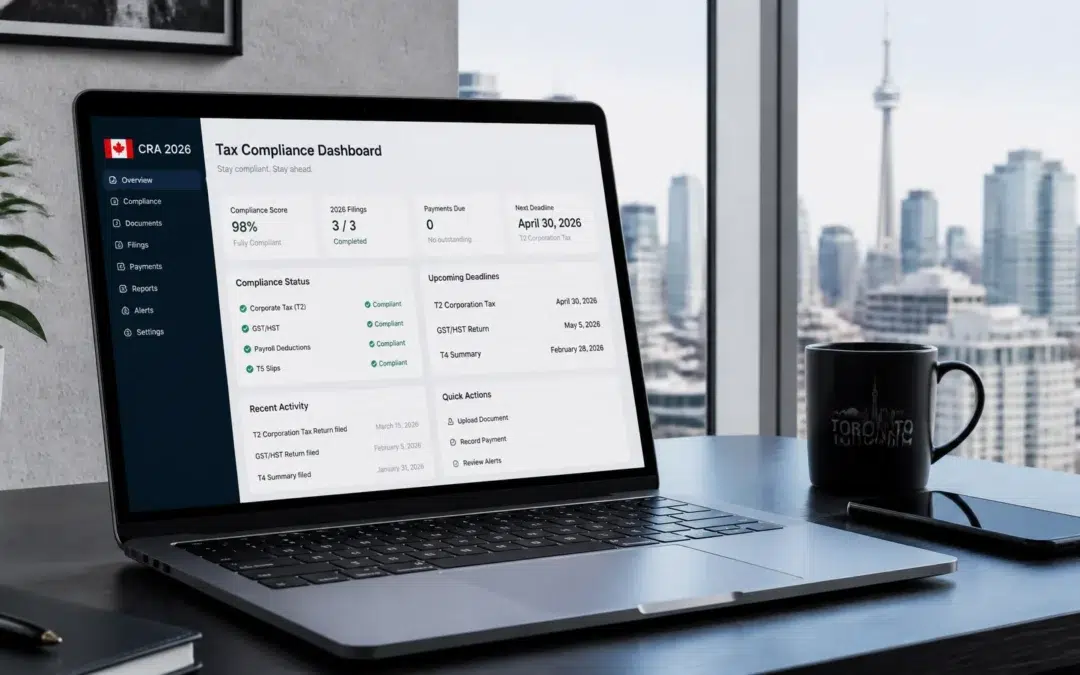
by Ariful | May 23, 2026 | Canada Updates
Navigating the Canadian tax landscape in 2026 requires more than just a calendar; it requires a proactive strategy. As the Canada Revenue Agency (CRA) moves toward a fully digital ecosystem, staying on top of daily updates is no longer optional for growing SMEs and e-commerce brands, it is a business necessity. Whether you are a non-resident vendor selling digital services or a local UK Limited Company expanding into the Great White North, understanding the shifting sands of GST/HST and corporate compliance is the key to your success.
At Sterlinx Global, we monitor these changes daily so you don't have to. Our goal is to ensure your business remains fully compliant while you focus on scaling. This guide breaks down everything you need to know about Canada’s tax environment in 2026, from the latest GST/HST thresholds to the implementation of the Digital Services Tax (DST).
Master the GST/HST Digital Economy Rules
One of the most critical areas for international sellers in 2026 is the "Digital Economy" GST/HST framework. Initially introduced in 2021, these rules have matured into a robust system that captures virtually all cross-border digital transactions. If you provide SaaS, digital downloads, or streaming services to Canadian consumers, you must remain vigilant.
The threshold remains at $30,000 CAD in taxable supplies over a 12-month period. Once you cross this line with sales to non-registered Canadian consumers (B2C), you are legally required to register, collect, and remit GST/HST. For many, the simplified registration regime is the most efficient path, but it does come with restrictions on claiming Input Tax Credits (ITCs).
Don't worry if this sounds complex. This is why a structured approach to bookkeeping is essential. By tracking your Canadian sales daily, you can anticipate when you'll hit that threshold and avoid the "back-tax" trap. For a deeper dive into these specifics, check out our guide on Canada tax latest 2026 GST/HST updates for digital services.
Navigate the Digital Services Tax (DST) Status
In 2026, the Digital Services Tax (DST) remains a high-priority watch item for large digital businesses. The Canadian government designed the DST to ensure that large multinational entities pay their fair share on revenue earned from the engagement of Canadian users.
If your global consolidated revenue exceeds €750 million and your in-scope Canadian digital services revenue is over $20 million CAD, you may be subject to a 3% tax on that revenue. This includes income from online marketplaces, advertising, and social media services. While the implementation has seen delays due to international negotiations (OECD Pillar One), Canada has signaled its intent to maintain a "made-in-Canada" solution if global consensus falters.
Monitoring these updates daily is vital because the DST can be applied retroactively in some legislative drafts. Keep a close eye on your revenue reporting to ensure you aren't blindsided by a significant tax bill at year-end.
Mark Your 2026 Corporate Filing Deadlines
Compliance is built on deadlines. For Canadian corporations (T2 filers), your dates are usually determined by your fiscal year-end rather than the calendar year. However, for those operating on a standard calendar year, 2026 brings specific milestones you cannot afford to miss.
- T2 Income Tax Return: This is due within 6 months after your fiscal year-end. For a 31 December 2025 year-end, your filing deadline is 30 June 2026.
- Balance of Tax Owing: Do not confuse the filing deadline with the payment deadline. Most corporations must pay their balance of tax 2 months after year-end (February 2026 for December year-ends).
- GST/HST Returns: If you are a monthly or quarterly filer, your return and payment are due one month after the end of your reporting period.
- Information Slips (T4/T5): If you have employees or pay dividends, these slips for the 2025 calendar year are due by 28 February 2026.
Missing these dates can result in heavy penalties and interest. To avoid these common pitfalls, read our article on 7 mistakes you’re making with CRA tax filings and how to fix them.
Adopt the New CRA Operational Standards
The CRA is making significant changes to how businesses interact with their systems in 2026. Two major updates stand out:
- Mandatory Multi-Factor Authentication (MFA): Starting in February 2026, the CRA requires a backup MFA method (like an authenticator app or passcode grid) for all "My Business Account" users. If you haven't updated your security settings, you may find yourself locked out during peak filing season.
- The End of Paper Drop Boxes: After the 2026 filing season, the CRA will permanently close physical drop boxes. The message is clear: transition to electronic filing and payment now.
At Sterlinx Global, our tech-driven system is already fully integrated with electronic filing protocols. We ensure that your data is uploaded securely and accurately, moving you away from the risks of manual, paper-based processes.
Stay Compliant with Daily Monitoring
The secret to "succeeding" in 2026 isn't just knowing the law; it's the daily execution of your compliance tasks. Tax updates can happen overnight, provincial PST rates might change, or the federal government might introduce new reporting requirements for specific sectors like trucking or short-term rentals.
Doing this yourself is a full-time job. This is why we position ourselves as your compliance partner. We don't just "advise" you once a year; we complete your compliance on an ongoing basis. You provide the data, and we handle the bookkeeping, tax calculations, and VAT/GST filings. This structured approach allows you to focus on growth while we handle the heavy lifting of the CRA.
Maintain your momentum by ensuring your cross-border operations are as streamlined as your local ones. For those also trading in the US, you might find our ultimate guide to USA tax compliance a helpful comparison to the Canadian system.
Let’s Secure Your Canadian Growth
Canada remains one of the most lucrative markets for digital businesses and SMEs, but the tax barrier to entry is real. In 2026, the difference between a thriving business and one bogged down by audits is the quality of its compliance suite.
Don't let a missed GST/HST update or a late T2 filing stall your expansion. Whether you need a full-suite accounting solution or modular VAT/GST support, we are here to help. Our team specializes in the specific needs of UK Limited Companies and international entities trading in Canada.
Ready to simplify your Canadian tax obligations? Contact us today to talk to an expert and discover how our daily compliance monitoring can protect your business.
Frequently Asked Questions (FAQ)
What is the GST/HST threshold for non-resident digital sellers in 2026?
The threshold remains at $30,000 CAD in taxable supplies to Canadian consumers within a 12-month period. Once exceeded, you must register for GST/HST under either the simplified or standard regime.
When is the 2026 deadline for Canadian corporate tax payments?
For most corporations with a December 31st year-end, the balance of tax owing is due by February 28, 2026. Note that the filing of the T2 return itself is not due until June 30, 2026.
Does Canada have a Digital Services Tax (DST) in 2026?
As of early 2026, Canada has moved forward with its own Digital Services Tax (DST) legislation, targeting large digital businesses with global revenues over €750 million and Canadian in-scope revenue over $20 million CAD.
Are CRA drop boxes still available for tax filings?
2026 marks the final filing season where physical drop boxes will be available. The CRA is phasing them out in favor of 100% electronic filing through the My Business Account portal.
Can I claim ITCs if I use the simplified GST/HST registration?
Generally, no. The simplified GST/HST registration for non-resident digital service providers does not allow you to claim Input Tax Credits (ITCs) on business expenses. If you have significant Canadian expenses, the standard registration may be more beneficial.

by Ariful | May 23, 2026 | Canada Updates
Staying compliant in the Australian market is a moving target, especially as we approach the second half of 2026. If you are operating a business in Australia, or expanding your international entity into the Aussie market, the Australian Taxation Office (ATO) has introduced several critical changes that require your immediate attention.
At Sterlinx Global, we know that tax compliance can feel like a mountain of paperwork. But here is the good news: staying on the right side of the ATO doesn't have to be a struggle. By focusing on a few key operational shifts now, you can avoid late payment fines and keep your business running smoothly.
This guide breaks down the essential 2026 Australian tax updates and provides a clear "do this first" checklist to ensure you remain fully compliant.
Prepare for Payday Super: The Biggest Shift in Payroll
The most significant change arriving on 1 July 2026 is the introduction of Payday Super. For years, Australian employers have typically paid Superannuation Guarantee (SG) contributions on a quarterly basis. That era is ending.
From July 2026, you must pay your employees' superannuation at the same time you pay their wages. This means if you pay your team weekly, you must also remit their super weekly.
Why this matters for your cash flow
This change is designed to ensure employees receive their retirement savings faster, but for you, it means a tighter cash flow cycle. You will no longer have a three-month "buffer" to hold onto superannuation funds.
Do this first: Review your cash flow forecasts immediately. You need to ensure that every single pay run accounts for the 12% SG rate (which became effective in 2025 and remains the standard for 2026). If you haven't already, move to an STP Phase 2 compliant payroll system to automate these calculations and reporting.
Master GST and Cross-Border Digital Compliance
While the core GST rate remains at 10%, the ATO has significantly ramped up its data-matching capabilities in 2026. If your business sells digital services or goods into Australia from overseas, or if you are a local SME trading internationally, the "invisible" eyes of the ATO are watching closer than ever.
The rise of automated data-matching
The ATO now uses high-quality data from banks, payment platforms, and customs to verify that the GST you report matches the reality of your transactions. We are seeing a major focus on:
- Under-reported income: Ensuring all marketplace sales (Amazon, eBay, Shopify) are captured.
- Ineligible GST credits: Scrutinizing business-related vs. personal expenses.
- Monthly reporting mandates: Businesses with a history of late lodgements are being moved from quarterly to monthly Business Activity Statements (BAS) to ensure tighter oversight.
Do this first: Ensure your e-commerce accounting is reconciled daily. Keeping your records clean ensures that when the ATO’s automated systems scan your data, everything aligns perfectly.
Benefit from the Permanent $20,000 Instant Asset Write-Off
There is some excellent news for small businesses in the 2026-27 budget. The government has proposed making the $20,000 instant asset write-off permanent from 1 July 2026.
This applies to businesses with an aggregate turnover of less than $10 million. If you need to buy new equipment, technology, or office furniture, you can deduct the full cost of eligible assets (under $20,000) immediately, rather than depreciating them over several years.
Maximizing your tax deductions
This measure is all about improving your cash flow. It allows you to reduce your taxable income in the same year you make a purchase.
Do this first: If you are planning significant equipment upgrades, talk to us about the timing. Aligning your purchases with the July 1st rollout can significantly impact your year-end tax position.
Navigate the 2026 Personal Income Tax Cuts
If you are a business owner or an employee, the personal tax landscape is shifting again. The More Cost of Living Relief Act 2025 has introduced new tax brackets and rates that take effect from 1 July 2026.
Updating your PAYG withholding
As an employer, you are responsible for withholding the correct amount of tax from your employees' pay. When these rates change, your payroll software must be updated to reflect the new withholding tables. Failure to do so can result in your employees being hit with unexpected tax bills at the end of the year.
Do this first: Ensure your payroll software provider has the 2026 tax tables ready to go before the first pay run in July. If you are a Sterlinx Global client, we handle these system updates as part of our ongoing compliance service.
The 2026 Australian Tax Compliance Checklist
Don't let the complexity of the ATO overwhelm you. Follow this simple checklist to stay ahead:
- Audit Your Payroll: Confirm your software is STP Phase 2 compliant and ready for the Payday Super transition.
- Reconcile GST Daily: Avoid the "BAS stress" at the end of the quarter by keeping your bookkeeping current.
- Review Cross-Border Sales: If you sell into Australia, ensure you are registered for GST if you exceed the $75,000 AUD threshold.
- Manage ATO Debt: The ATO is now disclosing business tax debts over $100,000 to credit bureaus. Keep your payments on track to protect your credit rating.
- Check Asset Purchases: Plan your capital expenditure to take advantage of the $20,000 instant asset write-off.
How Sterlinx Global Simplifies Your Compliance
Managing tax in Australia is about more than just filling out a form once a year; it’s about maintaining a constant, accurate record of your business activity. This is where Sterlinx Global steps in.
We are not just tax advisors; we are your Global Tax Compliance Suite. Our team focuses on the operational execution of your taxes. Whether you are a UK Limited Company expanding into Australia or a local SME scaling fast, we take the data you provide and turn it into compliant filings.
Our services include:
- Daily Bookkeeping: We keep your records updated so you always know your position.
- GST & BAS Filing: Accurate calculations and on-time submissions to avoid ATO penalties.
- Payroll & Super Management: Ensuring you are ready for the Payday Super shift.
- Year-End Accounts: Comprehensive reporting that meets all Australian regulatory standards.
Scaling a business across borders, from the UK and Europe to the USA, Canada, and Australia, requires a partner who understands the local nuances. You can learn more about how we support international entities here.
Don't wait for a letter from the ATO to start thinking about 2026. Take control of your compliance today.
Contact us to speak with an expert about your Australian tax compliance needs.
Frequently Asked Questions (FAQ)
What is Payday Super and when does it start?
Payday Super is a new requirement for Australian employers to pay superannuation contributions at the same time they pay wages. It officially begins on 1 July 2026.
Does the $20,000 instant asset write-off apply to my business?
If your business has an aggregate annual turnover of less than $10 million, you are eligible for the $20,000 instant asset write-off for qualifying assets purchased from 1 July 2026.
Do I need to register for GST if I sell digital services to Australia?
Yes, if your turnover from sales to Australian consumers exceeds $75,000 AUD in a 12-month period, you must register for GST and remit the 10% tax to the ATO.
Can the ATO report my tax debt to credit agencies?
Yes. The ATO has the power to disclose business tax debts to credit reporting bureaus if the debt is over $100,000 and is more than 90 days overdue.
How do the 2026 personal tax cuts affect my business?
As an employer, you must ensure your payroll systems are updated with the new 2026 tax brackets to correctly calculate PAYG withholding for your staff.

by Ariful | May 23, 2026 | US Updates
Navigating the American tax landscape as an international seller can feel like trying to solve a puzzle while the pieces are constantly changing shape. If you sell on Amazon, Shopify, or eBay into the United States from abroad, you already know that staying compliant is the only way to protect your business.
As we move through 2026, the IRS and various state authorities have introduced significant shifts in how they monitor and tax global sellers. Ignoring these updates isn't just a small oversight, it can lead to frozen accounts, massive penalties, and unnecessary withholding.
This is why we have compiled this essential guide. Whether you are operating through a UK Limited Company, a USA LLC, or a foreign corporation, these seven updates are critical for your 2026 operations.
1. The 1099-K Threshold Has Been Reset
For the past few years, there has been a lot of "will they, won't they" regarding the $600 reporting threshold. In 2026, we finally have clarity thanks to the latest federal legislation. The reporting threshold for payment apps and online marketplaces (Third-Party Settlement Organizations) has been officially reset.
The Update: Marketplaces will now only issue a Form 1099-K if you meet two specific criteria:
- Your total payments exceed $20,000.
- You have more than 200 transactions in the calendar year.
Why it matters to you: This higher threshold provides some breathing room for smaller international sellers. However, don't let this lull you into a false sense of security. Even if you don't receive a 1099-K, you are still legally required to report your U.S.-sourced income. Furthermore, payment card processors (like Visa or Mastercard) are still required to report any amount, meaning the IRS likely still has visibility into your cash flow.
To ensure you are reporting correctly, you should Talk to an expert about your specific marketplace data.
2. Form 5472 Penalties Remain a Major Threat
If you have set up a U.S. LLC to run your ecommerce business, you are likely classified as a "Foreign-Owned Disregarded Entity." This comes with a specific reporting requirement called Form 5472.
The Update: While the form itself isn't new, the enforcement in 2026 is stricter than ever. The penalty for failing to file, filing late, or filing an incomplete Form 5472 starts at $25,000 per year.
Actionable Step: You must file this form even if you didn't make a single sale. Why? Because the IRS tracks "reportable transactions," which include:
- Capital contributions (putting your own money into the LLC).
- Moving money from the LLC back to your personal account.
- Loans between you and your business.
Maintain strict records of every dollar that moves between you and your U.S. entity to avoid this life-changing fine.
3. Beneficial Ownership (BOI) Reporting is Mandatory
The Corporate Transparency Act (CTA) is now in full force for 2026. This isn't an IRS tax rule; it's a FinCEN (Financial Crimes Enforcement Network) requirement aimed at preventing money laundering.
The Update: Almost every small corporation or LLC registered in the U.S. (including those owned by non-U.S. residents) must file a Beneficial Ownership Information (BOI) report.
The Risk: Failing to file can result in civil penalties of up to $500 for each day that the violation continues. If you changed your address or your passport expired recently, you must update your BOI filing within 30 days.
Register Your Details: Don't wait for a notice to arrive. If you have a U.S. entity, ensure your BOI report is active and accurate. This is a separate filing from your tax return, and it is easy to forget.
4. Sales Tax: The Illinois "15% Warning"
Sales tax is managed at the state level, not the federal level. In 2026, states are becoming more aggressive in how they enforce "Economic Nexus", the rule that says you owe tax once you hit a certain sales volume in that state.
The Update: A prime example of this trend is the 2026 update from Illinois. Starting this year, if a taxpayer fails to provide the detailed data needed to determine where a sale originated or was delivered, the state may apply a punitive flat rate of 15% on those gross receipts.
The Consequence: Most states have an average sales tax rate of 6% to 9%. Paying 15% because your data is messy will destroy your margins.
- Track your sales by state: Use a structured system to categorize every order.
- Identify Nexus: Monitor when you cross thresholds like $100,000 or 200 transactions in a single state.
To avoid these aggressive state audits, Book a call with our compliance team today.
5. Marketplace Facilitator Laws Aren't a "Get Out of Jail Free" Card
Many sellers believe that because Amazon or Walmart collects sales tax on their behalf, they have zero responsibility. In 2026, that assumption is dangerous.
The Update: While marketplace facilitator laws do require platforms to collect tax, you may still be required to:
- Register for a sales tax permit in states where you have "physical nexus" (e.g., using Amazon FBA warehouses).
- File "zero-tax" returns to show the state that the marketplace handled the collection.
- Collect tax yourself for any sales made through your own website (Shopify/WooCommerce).
Keep Compliant: Check your inventory reports. If your goods are sitting in a warehouse in Pennsylvania, you likely have a registration obligation there, even if Amazon handles the tax at checkout.
6. Avoid the 24% Backup Withholding Trap
The IRS uses "Backup Withholding" to ensure they get their cut when they don't trust the information they have on a seller.
The Update: If your marketplace or payment processor (like PayPal or Stripe) does not have a valid W-8BEN (for individuals) or W-8BEN-E (for entities) on file, they are often required to withhold 24% of your gross sales and send it to the IRS.
The Benefit of Action: For an ecommerce business, 24% of gross sales usually exceeds your entire profit margin. Getting this money back from the IRS can take over a year.
- Verify your forms: Log into your seller accounts today and ensure your tax identity information is verified and up to date.
- Match your names: Ensure the name on your tax form matches exactly with the name on your bank account and marketplace profile.
7. Shift to Continuous Compliance
The days of "waiting until tax season" to look at your numbers are over for international sellers. The U.S. tax system in 2026 is data-driven. The IRS and state departments now use AI and data-sharing agreements to spot inconsistencies in real-time.
The Solution: You need a "Full Compliance Suite." This means your bookkeeping, tax calculations, and filings are handled on an ongoing basis.
- Daily Bookkeeping: Know your numbers every day so you can spot nexus thresholds before you cross them.
- Accurate Reporting: Ensure your intercompany agreements are in place for Form 5472 support.
- Professional Oversight: Having a partner like Sterlinx Global means you provide the data, and we handle the heavy lifting of compliance.
Why International Sellers Partner With Sterlinx Global
We understand that you want to focus on sourcing products and scaling your brand, not worrying about the latest IRS bulletin. Sterlinx Global is not just a consultancy; we are your end-to-end compliance delivery partner.
We specialize in helping UK Limited Companies and international entities navigate the complexities of cross-border trade. From VAT in Europe to Sales Tax and IRS filings in the USA, we ensure your business remains bulletproof.
Don't let a $25,000 penalty be the reason your expansion into the U.S. market fails. Let us handle the complexity while you handle the growth.
Ready to secure your U.S. business for 2026?
Contact us today to speak with a tax compliance expert.
Frequently Asked Questions (FAQ)
Do I need a US LLC to sell in the USA?
No, you can sell as a foreign entity (like a UK Limited Company). However, many sellers choose a US LLC for better access to US payment processors and marketplaces. Both options have different tax reporting requirements.
What is the penalty for not filing a BOI report in 2026?
The civil penalty can be up to $500 for each day the violation continues. Criminal penalties, including fines and imprisonment, may also apply for willful failure to report.
Does the $20,000 1099-K threshold mean I don't owe tax below that amount?
No. The threshold only determines when a marketplace must report your income to the IRS. You are legally required to report and pay tax on all U.S.-sourced income, regardless of whether you receive a 1099-K.
How do I know if I have Sales Tax Nexus?
You have nexus if you have a physical presence (like inventory in a warehouse) or if you exceed a state's economic threshold (commonly $100,000 in sales or 200 transactions).
Can Sterlinx Global help with both UK and USA taxes?
Yes. We provide a Full Compliance Suite covering the UK, Ireland, USA, Canada, and Australia. We also provide VAT-only services for the European Union.



