
by Ariful | May 23, 2026 | Canada Updates
Expanding your UK Limited Company into the Canadian market is a brilliant move. With a shared language, similar legal foundations, and a massive appetite for British brands, Canada is often the first "big" international leap for UK-based e-commerce and digital businesses. However, the Canada Revenue Agency (CRA) is known for its rigorous enforcement and evolving digital tax landscape.
As we move through May 2026, staying on top of daily Canada tax updates isn't just about avoiding fines, it is about protecting your profit margins. From the new "Last Sale" customs rules to the nuances of GST/HST registration, the goal is to keep your business moving without the sudden shock of an unexpected tax bill. At Sterlinx Global, we act as your compliance engine, ensuring that as rules change in Ottawa, your business in London or Manchester remains perfectly aligned.
Protect Your Margins with the 2026 "Last Sale" Rule
One of the most significant changes hitting UK sellers in 2026 is the Canada Border Services Agency (CBSA) overhaul of the "Value for Duty" regulations. If you are shipping physical goods from the UK directly to Canadian consumers (D2C), this update matters immensely.
Historically, some sellers were able to declare the value of goods based on an "upstream" price, essentially their cost of production or a previous sale in the supply chain. Under the 2026 "Last Sale" rule, the duty is now generally calculated on the final retail price paid by the Canadian customer.
Doing this will save you from unexpected costs: You must recalculate your landed cost models immediately. If you are the Importer of Record (IoR), the higher valuation means higher customs duties and a higher GST base at the border. This is why daily monitoring of trade notices is essential; a slight shift in how the CBSA interprets "substantial presence" for importers could change your tax liability overnight.
Master the $30,000 GST/HST Threshold
The Goods and Services Tax (GST) and Harmonized Sales Tax (HST) are the Canadian equivalents of VAT. For a UK business, the magic number is CAD $30,000. Once your taxable supplies to Canadian customers exceed this threshold over a rolling 12-month period, you are legally required to register with the CRA.
Don't worry; the process is structured, but you need to choose the right path:
- Simplified GST/HST Registration: This is designed for non-resident digital businesses (SaaS, e-books, streaming) that do not hold physical inventory in Canada. It allows you to collect and remit tax without the complexity of a full registration, though you generally cannot claim "Input Tax Credits" (ITCs) to recover GST paid on Canadian expenses.
- Regular GST/HST Registration: If you hold stock in a Canadian warehouse or 3PL, the CRA views you as "carrying on business" in Canada. In this case, you must use the regular registration. The major benefit here is the ability to claim ITCs, which can significantly offset the tax you pay at the border when importing your stock.
Keep your records clean: Whether you sell on Amazon, Shopify, or TikTok Shop, you must track which sales are handled by the platform (as a marketplace facilitator) and which are your direct responsibility. Even if a platform collects the tax, those sales still count toward your $30,000 registration threshold.
Avoid the "Permanent Establishment" Trap
A common fear for UK directors is inadvertently creating a "Permanent Establishment" (PE) in Canada, which would trigger Canadian Corporate Income Tax on your global profits. Under the UK-Canada tax treaty, simply selling goods online to Canadians does not usually create a PE.
However, certain actions can change this status:
- Opening a dedicated office or permanent physical location in Canada.
- Employing staff who have the authority to habitually conclude contracts on your behalf while in Canada.
- Owning or leasing a warehouse (though using a third-party 3PL typically does not trigger a PE).
According to the latest KPMG 2026 Spring Economic Update, federal corporate tax rates remain stable, but the administrative burden of a T2 Corporation Income Tax Return is something most UK SMEs want to avoid. By maintaining a clear "cross-border" structure, you can focus on growth without the complexity of dual-residency tax filings.
Watch the Pass-Through Costs of Digital Services Tax (DST)
While the Canadian Digital Services Tax (DST) is aimed at global tech giants with revenues in the hundreds of millions, its impact filters down to you. Platforms like Amazon, Google, and Meta often pass the cost of these 3% taxes onto their sellers and advertisers through increased service fees.
Stay informed to stay profitable: If you notice a sudden 3% hike in your platform referral fees or advertising costs, it is likely linked to these legislative shifts. This is why we emphasize daily updates, understanding the "why" behind fee increases allows you to adjust your pricing strategy before your monthly profit and loss statement takes a hit.
How Sterlinx Global Simplifies Your Canada Compliance
We know that as a business owner, you want to sell products, not spend your days reading CRA technical bulletins. This is where Sterlinx Global steps in. We provide a Full Compliance Suite for international entities, including:
- Daily Monitoring: We track CRA and CBSA changes so you don't have to.
- GST/HST Management: From initial registration to periodic filings and ITC claims.
- Accurate Reporting: We integrate with your e-commerce platforms to ensure every transaction is accounted for.
- Year-End Support: Ensuring your UK Limited Company filings correctly reflect your international trade.
Our operating model is simple: you provide the data, and we complete the compliance. Whether you need a full-suite solution or modular support for Canadian VAT/GST, we ensure you are fully compliant in the UK, USA, Canada, and beyond.
Ready to streamline your Canadian expansion? Contact us today to talk to an expert about your cross-border tax strategy.
Frequently Asked Questions
1. Do I need to pay Canadian income tax if I only sell online from the UK?
Generally, no. As long as you do not have a "Permanent Establishment" (like an office or dependent agents) in Canada, the UK-Canada tax treaty protects you from paying Canadian corporate income tax. However, you are still likely liable for GST/HST once you cross the $30,000 threshold.
2. What is the difference between GST, HST, and PST?
GST is the 5% federal tax. HST (Harmonized Sales Tax) combines the federal and provincial portions into one rate (13% to 15%) in participating provinces like Ontario. PST (Provincial Sales Tax) is a separate tax collected in provinces like British Columbia, Saskatchewan, and Manitoba.
3. Does Amazon collect Canadian tax for me?
Yes, for most sales to Canadian consumers, Amazon acts as a "Marketplace Facilitator" and collects the GST/HST. However, you may still be required to register for your own GST/HST number if you sell to businesses (B2B) or sell through your own website (Shopify/WooCommerce).
4. What is the "Last Sale" rule for 2026?
The "Last Sale" rule requires customs duties to be calculated based on the retail price paid by the consumer rather than the wholesale cost of the goods. This can significantly increase the cost of importing goods into Canada for D2C sellers.
5. Can I recover the tax I pay when importing stock into Canada?
Yes, if you have a "Regular" GST/HST registration, you can claim Input Tax Credits (ITCs) on the tax paid at the border, which effectively offsets the GST you collect from customers.
6. Is there a simplified way for UK SaaS companies to register?
Yes, the CRA offers a Simplified GST/HST registration for non-resident suppliers of digital products and services. It has fewer reporting requirements but does not allow for the recovery of Canadian business expenses.
by Ariful | May 23, 2026 | UK Accounting
Expanding your UK Limited Company into the Australian market is a bold and potentially lucrative move. Whether you are selling digital services, scaling an e-commerce brand, or establishing a local team, Australia offers a familiar legal framework but a distinct tax landscape. As we navigate through 2026, the Australian Taxation Office (ATO) has introduced several key updates that you cannot afford to ignore.
Staying compliant isn't just about avoiding fines, it's about building a sustainable, scalable operation. This guide breaks down the essential 2026 Australian tax updates, ensuring your UK business remains on the right side of the law while maximizing cross-border efficiency.
Master the Goods and Services Tax (GST) Threshold
The most immediate concern for any UK company trading in Australia is the Goods and Services Tax (GST). Australia's GST is a broad-based tax of 10% on most goods, services, and other items sold or consumed in the country.
For 2026, the GST registration threshold remains at AUD 75,000. If your Australian-sourced turnover meets or is expected to exceed this amount in any 12-month period, you must register for GST. This includes:
- Low-Value Imported Goods: If you sell physical goods valued at AUD 1,000 or less to Australian consumers.
- Digital Products and Services: SaaS, streaming services, and mobile apps are all subject to GST if sold to Australian residents.
- Marketplace Sales: If you sell via platforms like Amazon Australia or eBay, the platform may handle some GST, but your overall registration obligation depends on your total Australian revenue.
Keep your revenue tracking tight. If you cross the threshold and fail to register, the ATO can back-date your liabilities, leaving you with a significant bill and potential penalties. Using a structured system like the one we provide at Sterlinx Global ensures your monthly sales are monitored against these thresholds.
Navigate Corporate Tax Rates for 2026
If your UK Limited Company has a permanent presence in Australia, such as an office or a local subsidiary, you will be subject to Australian Corporate Tax. For the 2025-26 and 2026-27 income years, the tax rates are tiered based on your "Base Rate Entity" status.
- Base Rate Entities (25%): Most UK SMEs expanding to Australia will fall here. If your aggregated turnover is less than AUD 50 million and your passive income (like rent or interest) is 80% or less of your total income, you pay a competitive 25% rate.
- Standard Rate (30%): Larger companies or those with high passive income levels are taxed at 30%.
Don't worry about paying tax twice on the same profits. The UK–Australia Double Tax Agreement (DTA) is designed to prevent this. You can usually claim Foreign Tax Credit Relief in the UK for tax already paid in Australia. It is essential to maintain accurate reporting to ensure these credits are applied correctly.
Understand the Pillar Two Global Minimum Tax
From March 2026, Australia has fully integrated the OECD Pillar Two rules. While this primarily impacts large multinational groups with consolidated revenue over €750 million, it represents a significant shift in the global tax environment.
If your UK company is part of a larger international group, you must ensure that your effective tax rate (ETR) in Australia is at least 15%. If it drops below this due to local incentives, a "top-up tax" may be triggered. Even if you aren't a global giant yet, understanding these shifts helps you prepare for the reporting requirements that often trickle down through supply chains.
Review Your Intercompany Loans and Thin Capitalisation
Many UK parents fund their Australian operations through intercompany loans. However, the ATO has tightened the Thin Capitalisation rules for 2026 to prevent profit shifting via excessive interest deductions.
The new Fixed Ratio Test limits your net debt deductions to 15% of your "Tax EBITDA". If your interest payments to your UK parent exceed this ratio, the excess deductions may be denied.
Register your loan agreements properly. Ensure all intercompany financing is documented at arm's-length terms. This is a common audit trigger for the ATO, and staying organized now will save you hours of stress later. You can learn more about managing cross-border finances in our guide on why cross-border compliance matters for scaling digital brands.
Leverage the Permanent Asset Write-Off
In a win for growing businesses, the Australian government has made the AUD 20,000 instant asset write-off permanent starting July 1, 2026. This applies to small businesses with an aggregated turnover of less than AUD 10 million.
If your Australian branch or subsidiary purchases eligible assets (like office equipment or tech hardware) costing less than AUD 20,000, you can deduct the full cost immediately rather than depreciating it over several years. This is a fantastic way to manage cash flow while upgrading your local infrastructure.
Avoid the "Permanent Establishment" Trap
One of the biggest risks for UK Limited Companies is accidentally creating a Permanent Establishment (PE) in Australia. If the ATO determines you have a PE, you are required to lodge Australian tax returns and pay local corporate tax.
You might trigger a PE if you:
- Have a fixed place of business (like a dedicated office space).
- Have an employee in Australia with the authority to conclude contracts.
- Run a significant project (usually over 6 months) on Australian soil.
It is vital to clarify your status early. If you are unsure whether your activities cross the line, checking our quick start guide for UK Limited Company accounting can provide context on how we help businesses stay within compliance boundaries.
How Sterlinx Global Simplifies Australian Compliance
Managing tax across two hemispheres is a complex task, but you don't have to do it alone. Sterlinx Global provides a Full Compliance Suite in Australia, specifically designed for UK Limited Companies and international SMEs.
Our operating model is simple: you provide the data, and we complete the compliance. We handle your:
- GST Registrations and Filings: Ensuring you never miss a Business Activity Statement (BAS) deadline.
- Corporate Tax Filings: Navigating the 25% vs 30% rates and DTA benefits.
- Ongoing Bookkeeping: Delivering accurate reporting through our tech-driven system.
By centralizing your UK and Australian compliance, you gain a clear view of your global tax position without the headache of managing multiple local firms.
Checklist for Your Australian Expansion in 2026
To ensure your success in the Australian market, follow this essential checklist:
- Monitor the AUD 75k Threshold: Track your Australian sales monthly.
- Obtain a Certificate of Residence: Get this from HMRC to access reduced withholding tax rates under the DTA.
- Audit Your PE Risk: Review your local staff and contract-signing authority.
- Review Interest Deductions: Ensure intercompany loans comply with the 15% EBITDA rule.
- Claim Your Write-Offs: Utilize the permanent AUD 20k instant asset write-off for local equipment.
Scaling globally is a major milestone for any business. With the right compliance partner, the Australian market offers incredible opportunities for UK brands.
Need help navigating these updates?
Contact us today to speak with an expert about your Australian tax and GST requirements.
FAQs About Australian Tax for UK Companies
What is the GST registration threshold in Australia for 2026?
The GST registration threshold remains at AUD 75,000. If your Australian sales exceed this in a 12-month period, you must register and remit 10% GST to the ATO.
Can a UK Limited Company use the 25% Australian Corporate Tax rate?
Yes, if the company (or its Australian subsidiary) is a "Base Rate Entity" with an aggregated turnover of less than AUD 50 million and no more than 80% of its income is passive.
What is the "Pillar Two" tax update?
Pillar Two is a global minimum tax of 15% for multinational groups with revenue over €750 million. It became fully integrated into the Australian tax system in March 2026.
Does a UK company pay tax in both the UK and Australia?
While you may have filing obligations in both, the UK–Australia Double Tax Agreement generally prevents you from paying tax twice on the same profit through tax credits or exemptions.
Is the instant asset write-off still available in 2026?
Yes, the AUD 20,000 instant asset write-off has been made permanent for small businesses (turnover under AUD 10m) starting July 1, 2026.
by Ariful | May 23, 2026 | US Updates
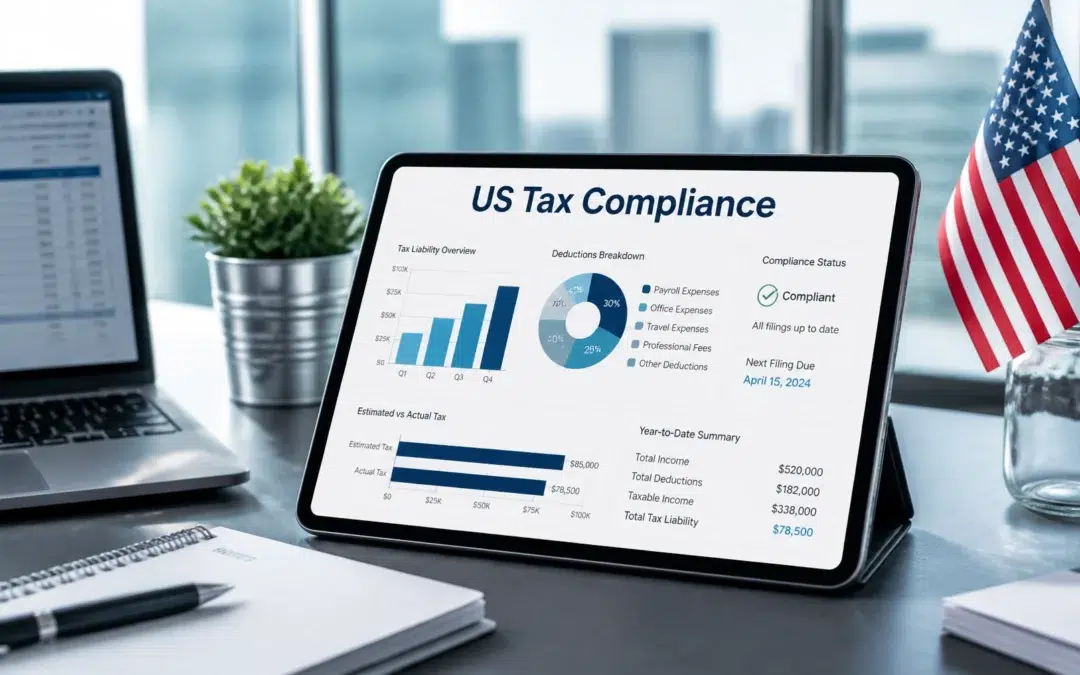
Selling into the United States is the ultimate goal for many international e-commerce brands and digital businesses. The market is vast, the consumers are ready, and the growth potential is limitless. However, the complexity of the US tax system can feel like a steep mountain to climb. Between federal IRS rules and the ever-changing landscape of state-level sales tax, staying compliant is no longer a "once a year" task, it is a daily requirement.
If you are a UK Limited Company, a Canadian Corporation, or an Australian entity trading in the USA, you need a structured approach to tax compliance. Rules change, thresholds shift, and reporting requirements evolve. This guide breaks down the essential 2026 updates you need to know and how to manage them without losing focus on your core business.
Separate Federal from State: The First Rule of US Compliance
Before diving into the latest updates, it is essential to understand that the US has two distinct layers of tax: Federal (IRS) and State (Department of Revenue).
The IRS handles federal income taxes, reporting forms like the 1099, and international treaties. State governments, on the other hand, manage Sales Tax and economic nexus. Don’t worry; while it sounds complicated, the key is knowing which rule applies to which activity.
For international sellers, most of the "daily" friction comes from Sales Tax, but 2026 has brought several federal reporting changes that could impact your operational costs and data requirements.
2026 Federal IRS Updates: What International Sellers Must Know
The IRS has introduced several updates for the 2026 tax year that aim to increase transparency and modernize reporting. If you use US-based payment processors or trade in digital assets, these rules apply directly to you.
Mastery of the 1099-K Reporting Thresholds
For several years, there has been back-and-forth regarding the threshold for Form 1099-K, which payment platforms like Stripe, PayPal, and Amazon use to report your gross sales to the IRS. For 2026, the threshold remains at $20,000 and 200 transactions.
While this is higher than the previously proposed $600 limit, it still means the IRS is receiving a direct feed of your US sales data. Ensuring your internal bookkeeping matches these 1099-K forms is critical to avoid "red flag" audits.
New Digital Asset Reporting (Form 1099-DA)
Starting in the 2025 tax year (reporting in early 2026), brokers are now required to issue Form 1099-DA for digital asset transactions. If your e-commerce business accepts cryptocurrency or uses digital wallets for US trade, you must maintain precise records of your cost basis and transaction dates. This update is part of a broader push to bring digital assets into the traditional tax fold.
The 1% Federal Remittance Fee
Effective January 1, 2026, a new 1% federal fee applies to certain money transfers sent from the US to international locations when funded by cash or money orders. Luckily, most digital businesses use electronic transfers, wires, or app-based funding, which are currently exempt. However, it highlights the importance of using modern neo-banking solutions to keep your cross-border costs low and your reporting clean.
Navigating State Sales Tax Nexus in 2026
Sales Tax remains the biggest hurdle for international sellers. In the US, there is no national VAT. Instead, you deal with over 45 different state tax jurisdictions, each with its own rules for "Nexus", the link that requires you to collect and remit tax.
Monitor Economic Nexus Daily
Economic nexus is triggered by your sales volume. Most states use a threshold of $100,000 in annual sales into that specific state. Some states have removed the "200 transaction" count, focusing purely on revenue.
Because you can cross these thresholds at any moment, you need a system that monitors your sales data daily. If you wait until the end of the quarter to check, you might already owe thousands in uncollected tax.
Inventory and Physical Nexus
If you use a 3PL or Amazon FBA, storing inventory in a US warehouse often creates physical nexus. Even if you haven't sold $100,000 in that state, the presence of your goods usually triggers a registration requirement. It is vital to track where your inventory is held to stay ahead of these obligations. You can read more about common US sales tax mistakes to ensure you aren't falling into the standard traps.
Operationalize Your Compliance with a Structured System
At Sterlinx Global, we don't believe in the "traditional" tax advisory model where you meet once a year to discuss the past. For a fast-growing SME or e-commerce brand, that is far too slow. We operate as a Global Tax Compliance Suite.
The goal is simple: You provide the data, we complete the compliance.
Daily Data Integration
To succeed in the US market, your data needs to flow seamlessly from your marketplace (Amazon, Shopify, TikTok Shop) to your accounting system. We specialize in taking that raw data and turning it into accurate, ready-to-file reports. This "daily" mindset ensures that when a deadline hits, the work is already done.
Filing and Deadlines
Missing a US tax deadline can result in heavy penalties and the revocation of your ability to trade in certain states. We handle the heavy lifting:
- Sales Tax Registrations: Getting you registered in the right states at the right time.
- Monthly/Quarterly Filings: Calculating exactly what is owed and ensuring it is paid on time.
- Year-End Accounts: For international entities like USA LLCs, ensuring your federal filings are accurate and compliant with the latest 2026 IRS adjustments.
Why International Sellers Choose Sterlinx Global
Managing US compliance from the UK, Canada, or Australia is challenging due to time zones, different terminology, and the sheer volume of state-level rules. This is why we have built a tech-driven system designed specifically for cross-border traders.
Whether you need a full-suite accounting service for your UK Limited Company and its US branch, or standalone US Sales Tax management, we provide the flexibility to scale. We understand the nuances of cross-border VAT and Sales Tax, ensuring you aren't double-taxed or left exposed to audits.
Keep Scaling, We’ll Handle the Rules
The 2026 changes are just another step in the evolution of global trade. By partnering with us, you aren't just getting an accountant; you are getting a compliance engine that stays updated on every IRS bulletin and state revenue change, so you don't have to.
Ready to simplify your US tax journey? Contact us today to talk to an expert about how we can manage your daily compliance and filings.
USA Tax Updates 2026: Frequently Asked Questions
Does the IRS handle my US Sales Tax?
No. The IRS handles federal income tax. Sales Tax is managed individually by each US state. You must register and file with each state where you have nexus.
What is the 1099-K threshold for 2026?
The current threshold for 1099-K reporting is $20,000 in gross sales and 200 transactions. This is the data that platforms like Amazon or Stripe report to the IRS.
What is Economic Nexus?
Economic nexus is a requirement to collect sales tax based on your sales volume into a state, typically $100,000 per year, even if you have no physical presence there.
Do I need a US bank account to pay my taxes?
While not always strictly required, having a US-compatible payment solution or a neo-bank account makes paying state and federal taxes significantly easier and cheaper.
How does Sterlinx Global help international sellers?
We provide a structured compliance service. You provide us with your sales and expense data, and we handle the bookkeeping, tax calculations, and filings for both state sales tax and federal requirements.
Are there new rules for digital assets in 2026?
Yes, the IRS now requires the use of Form 1099-DA to report transactions involving digital assets like cryptocurrency, starting with the 2025 tax year (reported in 2026).

by Ariful | May 23, 2026 | Canada Updates
If you are running a UK Limited Company and selling into North America, you’ve likely noticed that the Canadian Revenue Agency (CRA) hasn't been sitting still. In fact, 2026 has already seen some of the most significant shifts in Canadian tax law in over a decade. From the sudden repeal of the Digital Services Tax (DST) to new electronic filing mandates, keeping up with Canada’s daily tax updates has become a full-time job for international sellers.
Don’t worry, this is exactly why we track these changes for you. At Sterlinx Global, we specialize in ensuring that your cross-border compliance is handled daily, so you don't have to stress about the "what ifs" of Canadian tax law.
Here is why the latest updates from the CRA matter for your business and how you can stay ahead of the game.
The Big News: The Digital Services Tax (DST) Is Gone
The most significant update of 2026 came on March 26, when the Canadian government officially received Royal Assent to repeal the Digital Services Tax Act. For years, the 3% DST was a looming cloud over large digital businesses, platforms, and e-commerce giants.
This repeal means the 3% levy on revenue from digital services is no longer an ongoing obligation. While this is a massive win for simplicity, it doesn’t mean you are off the hook for Canadian taxes. It simply shifts the focus back to the primary compliance pillar: GST/HST.
Master the CAD 30,000 Small Supplier Threshold
For most digital service providers and e-commerce brands, the "Small Supplier" threshold is the magic number. In Canada, you are generally required to register for GST/HST once your taxable sales to Canadian customers exceed CAD 30,000 within any rolling 12-month period.
This is not a calendar year calculation. It is a "daily" monitoring task. If you hit that threshold today, you need to register. Failing to do so can lead to retroactive tax assessments and heavy penalties. By staying on top of your daily sales data, we ensure that you register at exactly the right time to avoid late-filing fines.
Use the Simplified GST/HST Regime for Digital Sales
If you are a non-resident vendor selling digital products (like SaaS, apps, or online courses) or a platform operator, the CRA offers a simplified GST/HST registration. This is designed to make your life easier by reducing the administrative burden.
- B2C Sales: You must charge GST/HST to Canadian consumers.
- B2B Sales: If your customer provides a valid GST/HST number, you generally do not charge the tax, and they self-assess.
- Rates: You must apply the correct rate based on the customer’s province. These range from 5% GST in Alberta to 15% HST in Atlantic Canada.
Navigating these rates across different provinces can be a headache. This is why we integrate our tax calculations directly with your data, ensuring the right amount is collected every time. If you've been struggling with your platform's tax settings, you might find our guide on 7 mistakes you’re making with your Amazon accounting particularly helpful.
E-Filing Is Now Mandatory for Everyone
As of early 2026, the CRA has made it clear: paper is out. Every GST/HST registrant (with very few exceptions) must file their returns electronically. If you try to mail in a paper return, you are likely to trigger a penalty.
Furthermore, if your tax payment is CAD 10,000 or more, it must be made through an electronic payment method. This shift toward a fully digital tax ecosystem means your bookkeeping must be precise and your data must be ready for e-filing at a moment's notice.
Avoid the Most Common CRA Filing Errors
We see businesses make the same mistakes repeatedly when trying to manage their Canadian compliance alone. Most of these errors are easily avoidable with the right structured system.
- Missing the 1-Month Deadline: For most monthly and quarterly filers, your return and payment are due exactly one month after the end of your reporting period.
- Incorrect Provincial Rates: Charging 5% when you should have charged 15% creates a liability that comes out of your own profit margins.
- Ignoring Provincial Sales Taxes (PST/QST): Some provinces, like British Columbia and Quebec, have separate systems that may require additional registrations.
If you are worried about your current filings, check out our deep dive into 7 mistakes you’re making with CRA tax filings.
Corporate Income Tax: Do You Have a Permanent Establishment?
One of the biggest questions we get from UK Limited Companies is whether they owe corporate income tax in Canada. Generally, if you sell digital products from the UK and have no physical presence (employees, offices, or servers) in Canada, you likely do not have a Permanent Establishment (PE).
However, this is a nuanced area. While you might be exempt from corporate income tax under a tax treaty, you are still fully responsible for GST/HST. The absence of an income tax liability does not mean you can ignore the CRA.
Your 2026 Canadian Compliance Checklist
To stay compliant with the latest changes, follow this simple checklist:
- Monitor Revenue: Check your 12-month rolling revenue daily to see if you've hit the CAD 30,000 mark.
- Verify GST Numbers: Ensure you are validating Canadian business customer GST numbers to correctly exempt B2B sales.
- Switch to E-Payments: Set up your banking to handle electronic transfers to the CRA for amounts over CAD 10,000.
- Update Your Invoicing: Ensure your invoices display your GST/HST number and the correct provincial tax rate.
Staying compliant in a foreign market shouldn't be a barrier to your growth. At Sterlinx Global, we take the operational weight of compliance off your shoulders. We don't just give advice; we handle the bookkeeping, the calculations, and the filings on your behalf.
Ready to simplify your Canadian tax compliance? Contact us or book a call with one of our experts today.
Frequently Asked Questions (FAQ)
What is the GST/HST registration threshold in Canada for 2026?
The threshold remains CAD 30,000 in taxable supplies over any rolling 12-month period. This applies to both resident and non-resident businesses selling to Canadian customers.
Is the Digital Services Tax (DST) still active in Canada?
No. As of March 26, 2026, the Digital Services Tax Act has been repealed. Businesses are no longer required to pay the 3% levy on digital service revenue.
Do I need to file my Canadian tax returns electronically?
Yes. As of 2024 and through 2026, the CRA requires all GST/HST registrants (except for specific charities) to file their returns and make large payments (over CAD 10,000) electronically.
How do I know which tax rate to charge in Canada?
The tax rate depends on the province of the customer. It varies from 5% GST (in provinces like Alberta) to 15% HST (in provinces like Nova Scotia and New Brunswick).
Does Sterlinx Global handle Canadian GST/HST filings?
Yes. We provide a full compliance suite that includes bookkeeping, tax calculations, and GST/HST filings for UK Limited Companies and international entities selling in Canada.
by Ariful | May 23, 2026 | Business
The Australian Taxation Office (ATO) is entering a new era of digital enforcement. If you are running a UK Limited Company with Australian operations, a local SME, or a digital business scaling in the Australian market, the compliance landscape is shifting beneath your feet. As of May 2026, the ATO has integrated real-time data matching across payroll, marketplaces, and banking systems.
Managing your tax obligations is no longer a quarterly check-in; it is a daily operational requirement. This update breaks down the most critical changes you need to address this month to avoid penalties and ensure your business remains compliant.
The Shift to Payday Super: No More Quarterly Buffers
The biggest change on the horizon, and the one you must prepare for in May 2026, is the transition to Payday Super. While the official start date for mandatory real-time payments is 1 July 2026, the ATO expects businesses to have their systems and cash flow projections ready now.
Align Your Cash Flow with Pay Dates
Traditionally, Australian employers could hold onto superannuation contributions and pay them quarterly. This provided a significant cash flow buffer. From July, you must pay superannuation at the same time you pay wages. This means if you pay your staff weekly, you pay their super weekly.
Real-Time Monitoring via STP Phase 2
The ATO is already using Single Touch Payroll (STP) Phase 2 data to monitor these obligations. By May 2026, the data-matching algorithms are fully optimized. If your STP reports show a wage payment without a corresponding superannuation accrual and subsequent payment, it will trigger an automated flag.
Don't worry, this is why we emphasize structured, daily bookkeeping. Waiting until the end of the month to reconcile your payroll will result in missed deadlines and non-deductible Super Guarantee Charge (SGC) penalties.
Marketplace and Platform Reporting: The ATO is Watching Your Sales
If you sell through Amazon, eBay, Shopify, or freelance platforms like Upwork and Uber, the ATO's "Sharing Economy Reporting Regime" is now in full swing.
Automated Cross-Matching
Digital platforms are now required to report transaction data directly to the ATO. In May 2026, the ATO is cross-referencing this data against your Business Activity Statements (BAS) and Income Tax Returns. If the sales reported by Amazon don't match the GST you've declared, you can expect an automated audit letter.
Maintain Accurate Digital Records
To avoid these discrepancies, you must ensure your ABN and GST registration details are perfectly aligned across all platforms. At Sterlinx Global, we specialize in ensuring your marketplace data is pulled daily and reconciled against your bank feeds, so your ATO reporting is always accurate.
New Personal Tax Cuts: Update Your Payroll Software Now
Starting 1 July 2026, a new set of personal income tax cuts will take effect. While this is great news for your employees, it creates an immediate administrative task for you in May and June.
Update Tax Tables Before July 1
The PAYG withholding rates are changing. You must ensure your payroll software is updated with the 2026-27 tax tables before your first pay run in July. Failing to update these tables will result in incorrect withholding, which can lead to significant headaches during year-end reconciliations.
Compliance Checklist for Payroll:
- Verify STP Phase 2 Compliance: Ensure every employee detail (TFN, date of birth, and income type) is accurate.
- Set the Super Rate to 12%: The super guarantee rate remains at 12% for the 2025-26 and 2026-27 financial years.
- Audit Your Allowances: The ATO is specifically looking at how allowances (travel, laundry, car) are reported under the new STP rules.
The $20,000 Instant Asset Write-Off is Now Permanent
For SMEs with an annual turnover of less than $10 million, there is a significant benefit in the May 2026 update. The Government has moved to make the $20,000 instant asset write-off a permanent fixture of the tax code.
Invest in Your Business Growth
This means you can immediately deduct the full cost of eligible assets, such as computers, office furniture, or specialized equipment, costing less than $20,000. If you are planning a technology upgrade, doing so before the 30 June year-end can provide a powerful deduction for your 2025-26 tax return.
Keep Detailed Tax Invoices
Remember, the ATO requires a valid tax invoice for every claim. In a world of digital enforcement, "near enough" is no longer good enough. Every deduction must be supported by a digital record that matches your bank transactions.
Why Daily Compliance is Your Only Shield
The recurring theme of the May 2026 updates is immediacy. The ATO is moving away from retrospective audits and toward real-time intervention.
Avoid Debt Disclosure to Credit Bureaus
The ATO has increased its powers to disclose significant tax debts (over $100,000) to credit reporting bureaus. A late BAS or unpaid super balance could now directly impact your business's ability to secure financing or trade with suppliers.
Sterlinx Global: Your Global Tax Compliance Suite
This is where the traditional "once-a-year accountant" model fails. You need a partner that handles your compliance as it happens. At Sterlinx Global, we don't just advise; we execute.
You provide the data, and we complete your bookkeeping, tax calculations, GST filings, and payroll on an ongoing basis. Whether you are managing a UK Limited Company with Australian sales or a fast-growing local SME, we ensure your data is "ATO-ready" every single day.
Action Plan for May 2026
To keep your business on the right side of the ATO, follow this structured checklist:
- Review Cash Flow for Payday Super: Calculate what your weekly or fortnightly super liability will look like starting July 1.
- Reconcile Marketplace Sales: Check your Amazon or Shopify payouts against your accounting software to ensure no income is being missed.
- Confirm Payroll Software Updates: Reach out to your software provider to ensure the 1 July 2026 tax tables are ready to go.
- Digitize Every Receipt: Use a tool like Dext or Hubdoc to ensure every expense has a digital tax invoice attached.
- Schedule a Compliance Review: If you are unsure if your current setup meets the 2026 requirements, now is the time to act.
The 2026 tax landscape is complex, but it doesn't have to be overwhelming. By staying organized and utilizing a tech-driven compliance partner, you can focus on scaling your business while we handle the data.
Don't wait for an ATO notification to find out you've missed a change. Stay proactive, stay compliant, and keep growing.
Contact us today to see how our Global Tax Compliance Suite can take the weight of Australian tax off your shoulders. Talk to an expert and ensure your business is ready for the 1 July 2026 transition.
FAQ: ATO Reporting Changes May 2026
When does Payday Super actually start?
The mandatory requirement for employers to pay superannuation at the same time as wages begins on 1 July 2026. However, you should be preparing your systems and cash flow in May 2026.
What is the current Super Guarantee rate for May 2026?
The rate is currently 12%. It was increased to 12% on 1 July 2025 and remains at this level for the 2026 financial year.
Does the ATO really see my Amazon or Shopify sales?
Yes. Under the Sharing Economy Reporting Regime, digital platforms are legally required to report transaction data to the ATO. Discrepancies between these reports and your BAS will likely trigger an audit.
Can I still claim the $20,000 instant asset write-off?
Yes, for small businesses with an annual turnover under $10 million, the $20,000 threshold has been made permanent for eligible assets.
How do I update my payroll for the July 2026 tax cuts?
Most cloud-based payroll systems (like Xero or QuickBooks) will update tax tables automatically. However, you must verify that these updates are applied before your first pay run in July 2026.



