
by Ariful | Jul 13, 2026 | UK Updates
TITLE: Best Digital Banks for UK Limited Companies: 2026 Comparison Guide
Choosing the right banking partner is one of the most critical decisions you will make for your UK Limited Company. In 2026, the traditional high-street banks are no longer the default choice for agile SMEs, e-commerce sellers, and digital agencies. The rise of sophisticated fintech platforms has changed the landscape, offering faster setup times, lower fees, and seamless integrations with your accounting software.
However, “digital-first” doesn’t always mean “best for your specific needs.” Whether you are a solo consultant or a rapidly growing e-commerce brand trading across borders, your choice of bank will impact your daily efficiency and long-term compliance. In this guide, we compare the top digital banking solutions for UK Limited Companies to help you make an informed decision.
Why traditional banking often fails UK Limited Companies
For decades, UK businesses were tied to the “Big Four” banks. While these institutions offer stability, they often struggle with the speed and flexibility that modern digital businesses require. If you have ever waited three weeks just to open an account or faced exorbitant fees for receiving a payment in USD, you know the frustration.
Digital banking solutions have solved these pain points by offering:
- Instant Account Opening: Most accounts can be opened in hours, not weeks.
- Seamless Tech Stacks: Direct API connections to tools like Xero and QuickBooks.
- Global Readiness: Built-in multi-currency wallets for international trade.
- Transparent Pricing: Clear fee structures without the hidden “maintenance” costs common in traditional banks.
The Top Contenders: 2026 Comparison
To choose the right partner, you need to understand the strengths and limitations of the major players. Here is how the leading digital solutions stack up for a UK Limited Company.
Starling Bank: The All-Rounder
Starling remains a top choice for UK SMEs because it offers a full UK banking licence with zero monthly fees for most standard business accounts. It is perfect if you want a “proper” bank without the traditional baggage.
- Best for: Businesses looking for a fee-free, fully licensed UK bank with excellent app-based management.
- Key Advantage: Your deposits are protected up to £85,000 by the Financial Services Compensation Scheme (FSCS).
- Integration: Strong native connections with accounting platforms and a “Business Toolkit” for VAT estimation.
Monzo Business: The UX Leader
Monzo has gained massive popularity for its intuitive interface and “Tax Pots” feature, which allows you to automatically set aside a percentage of your income for Corporation Tax or VAT.
- Best for: Small teams and freelancers who value a clean user experience and simple budgeting tools.
- Key Advantage: The “Pro” tier includes built-in invoicing and multi-user access, which is essential as your team grows.
- Integration: Excellent real-time notifications and direct links to accounting software.
Revolut Business: The International Powerhouse
Revolut has evolved from a travel card into a comprehensive financial operating system. In 2026, it operates with a full UK banking licence, making it more competitive than ever for established SMEs.
- Best for: Fast-growing companies and e-commerce brands with high transaction volumes and international needs.
- Key Advantage: You can hold, exchange, and send more than 25 currencies at competitive rates.
- Integration: Deep integrations with platforms like Shopify, Amazon, and various accounting suites.
Wise Business: The FX Specialist
While not technically a “bank” (it is an e-money institution), Wise is often the go-to secondary account for any UK company trading globally. Their transparent mid-market exchange rates are difficult to beat.
- Best for: Companies receiving high volumes of international payments or paying overseas suppliers.
- Key Advantage: You get local account details for the US, EU, Australia, and more, allowing you to get paid like a local.
- Constraint: Because it is not a bank, it does not offer FSCS protection, and you cannot deposit cash or cheques.
Tide: The Admin Specialist
Tide is designed specifically for small business owners who want to automate as much admin as possible. They offer quick setup and a range of tools to help you manage your company’s “to-do” list.
- Best for: New startups and UK-only businesses focused on simplicity.
- Key Advantage: Very easy company registration process (they can even register your Ltd company for you).
- Constraint: Limited international functionality compared to Revolut or Wise.
Protecting your funds: FSCS vs. Safeguarding
One of the most important factors in your decision is how your money is protected. You will see two main terms: FSCS Protection and Safeguarding.
FSCS Protection (Starling, Monzo, Revolut Bank): If the bank fails, the UK government guarantees your deposits up to £85,000. This provides the highest level of security for your company’s cash reserves.
Safeguarding (Wise, Tide): As e-money institutions, these providers are required by law to keep your funds in separate, low-risk accounts at regulated banks. If the provider goes bust, your money is still there, but it is not government-guaranteed in the same way as a full bank.
The Multi-Currency Factor for International Growth
If you are an e-commerce seller on Amazon or a digital agency with clients in the USA, your banking choice is directly linked to your profit margins. Traditional banks often charge 2% to 4% on currency conversions.
For a company doing £500,000 in international sales, choosing a platform like Wise Business or Revolut Business over a traditional bank could save you £15,000 or more annually in FX fees alone. This is money that stays in your business rather than going to a bank.
Integrating your bank with your accounting compliance
At Sterlinx Global, we don’t just see a bank account as a place to store money; we see it as a data source. To maintain full compliance and accurate reporting, your bank must “talk” to your accounting system every day.
We specialise in taking that data and turning it into accurate bookkeeping, VAT filings, and year-end accounts. When you choose a bank like Starling or Monzo, the bank feed is reliable and real-time. This allows us to deliver on our commitment as a Global Tax Compliance Suite, ensuring your filings are always up to date without you having to manually upload CSV files every month.
Don’t let manual data entry slow you down. By choosing a digital bank with strong API support, you enable us to provide a more efficient, tech-driven service for your UK Limited Company.
Sterlinx Verdict: Which one should you pick?
The “best” solution usually depends on your company’s footprint:
- For the UK-Centric SME: Starling Bank is our top recommendation. It is free, fully licensed, and the integrations are rock-solid.
- For the Global E-commerce Seller: Use a combination. A Starling Bank or Monzo account for your main GBP operations, paired with a Wise Business or Revolut Business account for international payments and multi-currency management.
- For High-Frequency International Trading: Revolut Business offers the best all-in-one solution with its full banking licence, multi-currency support, and deep integrations.
- For Budget-Conscious Startups: Monzo provides excellent UX and budgeting tools at competitive rates.
- For Admin-Heavy Small Businesses: Tide excels at simplifying company registration and administrative tasks.
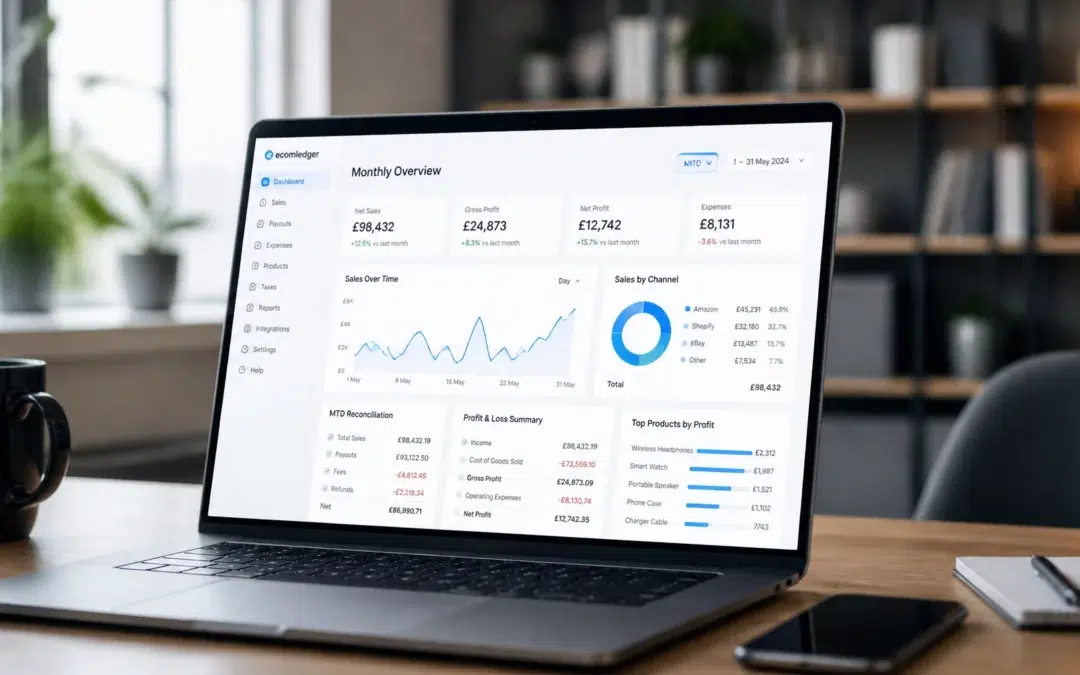
by Ariful | Jul 13, 2026 | Tax & Accounting
TITLE: How Marketplace Sellers Can Master MTD for VAT Without the Headache
If you are an Amazon or eBay seller approaching your first Making Tax Digital (MTD) for VAT filing, you might be feeling a bit of a headache coming on. You look at your bank account, then you look at your Amazon Seller Central or eBay Hub, and the numbers just… don’t match.
Don’t worry, this is one of the most common hurdles for growing SMEs. The mismatch happens because marketplaces don’t pay you exactly what you sold in a calendar month; they pay you in “settlements” or “payouts” that often overlap VAT quarters.
As an amazon seller accountant uk, we see this every day. The good news? There is a simple trick to bridge this gap, ensure your records are 100% MTD-compliant, and keep HMRC happy without spending your entire weekend in a spreadsheet.
Why Your Bank Balance is Lying to You (and Your VAT Return)
The biggest mistake new sellers make is trying to do their accounting based on the cash that hits their bank account. If Amazon sends you £5,000 on the 2nd of the month, that isn’t your turnover. That £5,000 is your gross sales, minus Amazon’s fees, minus refunds, minus advertising costs, and potentially minus a “reserve” they’ve held back.
HMRC requires you to report your gross sales (before fees) and then claim back the VAT on those fees as an expense. If you only report the net amount you received in the bank, you are likely under-reporting your turnover and missing out on valuable tax deductions. This is why having a specialist ecommerce accountant uk is vital to ensure you aren’t overpaying or under-reporting.
The Simple Trick: The Consolidated Digital Sales Ledger
The “trick” isn’t a secret piece of software, though tools help. The trick is moving away from “payout-based” accounting and moving toward “transaction-based” digital records.
Instead of looking at what you received, you create a single “Digital Sales Ledger” that merges your Amazon and eBay data into one standardized format. This creates a “digital link”, a core requirement of MTD, from the moment a customer clicks “buy” to the moment you file your return.
Step 1: Gather the “Trinity” of Reports
To make this work, you need three specific reports for your VAT period:
- Transaction Reports: These show every individual sale and the VAT rate applied (Standard, Zero, or Exempt).
- Fee Invoices: Monthly VAT invoices from Amazon or eBay that show the tax you paid on their commissions.
- Settlement/Payout Reports: These are the “keys” that help you prove the bank deposits match the sales.
Step 2: Map Your VAT Rates Automatically
One of the best ways to simplify this is to map your SKUs to VAT rates before you even start the reconciliation. By assigning a VAT code to each product in your master list, you can use a simple “VLOOKUP” or an automated accounting integration to calculate exactly how much VAT is owed on a thousands of orders in seconds.
This ensures that if you sell a mix of standard-rated and zero-rated goods (like children’s clothes or books), your MTD filing remains accurate. For more on how to manage these nuances, check out our UK Limited Company Accounting 101 guide.
Bridging the Gap: The Payout Reconciliation
Once you have your total gross sales, you need to “reconcile” them to your bank. This is where most sellers get stuck.
The Formula for Success:
Gross Sales – Refunds – Marketplace Fees + Adjustments = Total Payout
If your total payout matches the sum of the deposits in your bank account for that period, you have achieved a perfect reconciliation. This is the gold standard for HMRC compliance. If there is a difference, it is usually due to a “reserve” held by the marketplace. By tracking these reserves as a “current asset” on your balance sheet, your books will always stay balanced.
Stay MTD Compliant with Digital Links
HMRC’s MTD rules for 2026 are strict: you cannot simply “copy and paste” numbers from a marketplace report into your VAT return. You must maintain a “digital link.”
This is why at Sterlinx Global, we operate as a Global Tax Compliance Suite. We don’t just give you advice; we handle the daily heavy lifting. We use tech-driven systems to pull your data directly from Amazon and eBay, ensuring that every penny is accounted for with a clear, unbreakable digital trail. This saves you hours of manual data entry and eliminates the risk of human error that leads to late payment fines.
Checklist for Your First MTD Filing
- Register for MTD: Ensure you are registered through the HMRC gateway for Making Tax Digital.
- Identify Your Tax Points: Remember, the VAT is due based on the order date, not the date you got paid.
- Separate UK vs International Sales: Ensure you aren’t accidentally paying UK VAT on exports to the USA or Australia. For sellers moving goods across borders, our Ultimate Guide to Cross-Border VAT is an essential read.
- Keep Your Fee Invoices: Don’t just look at the “Fees” column in a report; download the actual VAT invoice to reclaim the input tax correctly.
- Verify Your Digital Links: Ensure your data flows from the marketplace to your software without manual re-typing.
How Sterlinx Global Makes This Easy
Managing multi-channel sales across Amazon, eBay, and Shopify is a full-time job. You should be focusing on sourcing products and growing your brand, not wrestling with settlement reports.
Sterlinx Global provides a structured, tech-driven compliance service. We specialize in ecommerce and digital businesses, delivering accurate reporting, VAT management, and year-end filings. Whether you are a UK Limited Company or an international entity selling into the UK, we ensure you are fully compliant across the UK, USA, Canada, Australia, and Europe.
We handle the bookkeeping and calculations on an ongoing basis, you provide the data, and we complete the compliance. It is that simple.
Frequently Asked Questions
What happens if I miss an MTD deadline?
HMRC operates a points-based penalty system. Missing a filing or payment deadline can result in financial penalties that scale with the frequency of the defaults. It is essential to stay organized.
Do I need a different accountant for Amazon and eBay?
No. A specialist amazon seller accountant uk like Sterlinx Global is equipped to handle all your marketplaces simultaneously, consolidating the data into one clear financial picture.
Can I still use spreadsheets for MTD?
Yes, but they must be linked to HMRC via “bridging software” and must maintain digital links between your raw data and the final summary. Manual data entry between sheets is generally not compliant.
What about sales to the EU or USA?
Cross-border sales have different VAT and Sales Tax rules (like OSS in the EU or Sales Tax in the US). We provide VAT-only services in the EU and full compliance suites in the USA, Canada, and Australia to keep you covered globally.
Ready to stop stressing over your

by Ariful | Jul 12, 2026 | US Updates
TITLE: 7 Critical Section 321 Reform Mistakes Sellers Are Making in 2026 (And How to Fix Them)
If you’ve been selling into the US market for any length of time, you likely know the "magic number": $800. For years, the Section 321 de minimis exemption allowed ecommerce businesses to ship low-value goods into the United States duty-free and with minimal paperwork. It was the backbone of many "drop-shipping" and direct-to-consumer models.
But things have changed, fast. By July 2026, the landscape of US customs is unrecognizable compared to just a few years ago. Executive orders and new Customs and Border Protection (CBP) policies have effectively dismantled the duty-free benefit for many, particularly those sourcing from China or using high-volume fulfillment hubs.
At Sterlinx Global, we see many SMEs struggling to keep up. Relying on outdated advice is the fastest way to get your shipments seized or your margins destroyed by unexpected fines. Here are the seven biggest mistakes we see sellers making with the Section 321 reform and exactly how you can fix them to keep your business growing.
1. Operating as if the "$800 Rule" is Still Universal
One of the most common mistakes is assuming that because the Section 321 statute still mentions an $800 threshold, your $50 parcel is automatically safe. In 2025 and 2026, policy shifts have essentially suspended duty-free treatment for a massive chunk of commercial imports.
The Fix: Treat All Parcels as Dutiable
Stop looking for the "free" window. Instead, bake duty and tax estimates into your pricing model from the start. Even if a shipment is small, modern CBP systems are now designed to collect duties on almost everything. This proactive shift prevents "sticker shock" for your customers and protects your bottom line.
2. Ignoring Strict Country-of-Origin Restrictions
If your goods are manufactured in China or Hong Kong, the old Section 321 rules largely no longer apply to you. Recent reforms have explicitly removed de minimis eligibility for goods subject to Section 301, 201, or 232 tariffs. Trying to "wash" the origin by routing through a third country like Mexico or Canada is a high-risk strategy that CBP is now actively targeting.
The Fix: Ensure Full Transparency in Your Supply Chain
Be honest and detailed about where your goods are made. If your products are from China, prepare for the standard tariff rates plus any specific e-commerce postal surcharges that may apply. We recommend working with us to map your supply chain and ensure you’re not accidentally claiming exemptions you no longer qualify for.
3. Submitting Vague or Incomplete Data
In the past, you could get away with describing a shipment as "electronics" or "apparel." Not anymore. The 2026 compliance environment requires detailed advance data for every single parcel. CBP now demands specific HTS (Harmonized Tariff Schedule) codes, accurate descriptions, and full details for both the shipper and the final recipient.
The Fix: Implement Automated HTS Classification
Don't guess your codes. Use professional tools or services to pre-assign HTS codes to your entire SKU catalog. Ensuring every shipment has the correct 10-digit code before it leaves the warehouse will drastically reduce the chances of customs delays and inspections.
4. Falling into the "One Person per Day" Trap
Section 321 has always had a rule that a person can only receive $800 worth of goods duty-free per day. However, with the new high-tech screening systems used by CBP in 2026, they can now easily aggregate shipments to the same address or person across different carriers. If you’re splitting large orders into multiple small boxes to "beat the system," you’re likely to get caught.
The Fix: Consolidated Shipping and Proper Entry
If your customer orders $1,200 worth of goods, don't split it into two boxes. File a formal or informal entry (CBP Form 7501) for the full amount. It might cost a bit more in duties, but it’s significantly cheaper than having your shipments flagged for "structured entry" fraud.
5. Failing to Screen for Restricted or Prohibited Items
With the increased scrutiny on small parcels, CBP is using Section 321 reforms as a tool to crack down on intellectual property (IP) violations and health and safety risks. Items that used to fly under the radar in high-volume mail are now being intercepted by AI-powered scanning.
The Fix: Conduct Regular Compliance Audits
Stay updated on the latest restricted items list. If you are selling digital accessories, cosmetics, or branded goods, ensure you have all the necessary certifications and IP authorizations ready to present. At Sterlinx Global, we help our clients maintain a compliance "vault" so that if CBP asks questions, the answers are already prepared.
6. Not Re-Modeling Your Landed Cost
Many SMEs scaled their business based on the high margins afforded by duty-free shipping. If your business model relies entirely on the absence of taxes, the 2026 reforms are a major threat. We’ve seen businesses lose 20-30% of their margin overnight because they didn't account for new brokerage fees and duties.
The Fix: Update Your Financial Planning Immediately
It’s time to run the numbers again. Calculate your "landed cost", the total price of a product once it has arrived at the customer's door, including all shipping, duties, and taxes. If the numbers don't work, you may need to adjust your pricing or look at alternative fulfillment strategies, such as a US-based warehouse. Contact us today if you need help recalculating these costs for your specific product lines.
7. Staying Stuck in Manual Compliance Processes
The sheer volume of data required for 2026 US customs compliance makes manual entry impossible for a growing business. If you are still typing out customs declarations by hand or using basic spreadsheets, you are prone to errors that will lead to shipping delays and penalties.
The Fix: Use a Global Tax Compliance Suite
Leverage technology to handle the heavy lifting. Our systems at Sterlinx Global are designed to integrate with your sales platforms to provide ongoing, daily compliance management. From bookkeeping to VAT and Sales Tax filings, we ensure that the data you provide to customs is accurate, consistent, and filed on time.
Navigating the New Era of US Trade
The "Wild West" days of duty-free ecommerce into the US are over. While the Section 321 reform feels like a hurdle, it’s also an opportunity to professionalize your operations. Businesses that adapt quickly and prioritize compliance will find it much easier to scale without the constant fear of customs issues.
Don't let a simple paperwork error stop your growth. At Sterlinx Global, we specialize in helping UK Limited Companies and international sellers navigate the complexities of cross-border trade. Whether you need help with US accounting or global VAT management, we are here to ensure you stay compliant and profitable.
Frequently Asked Questions
Is the $800 threshold completely gone?
Technically, no. The $800 limit still exists in the US law. However, executive orders have suspended the duty-free benefit for many categories, especially those from China. For most commercial e-commerce, the functional limit is now much lower or zero.
What happens

by Ariful | Jul 11, 2026 | UAE Updates
TITLE: Master Your UAE Business Setup: A 5-Step Guide for Digital Brands
Entering the UAE market is no longer just a luxury for global businesses, it is a strategic necessity. With digital ad spend projected to hit $2.64 billion by 2026, the United Arab Emirates has transformed into a global hub for e-commerce, SaaS, and digital agencies. For a digital brand, the lure of 100% foreign ownership, world-class infrastructure, and a competitive tax environment makes the UAE an irresistible destination for expansion.
However, moving your business to the "City of Gold" requires more than just a flight ticket. You need a structured plan to navigate the nuances of jurisdictions, licensing, and the recently updated tax landscape. At Sterlinx Global, we specialize in helping international businesses bridge the gap between their home markets and the UAE, ensuring that every box is ticked and every filing is finished on time.
Follow this easy 5-step guide to master your UAE business setup and position your digital brand for long-term success.
1. Clarify Your Digital Model and Research the Market
Before you register a company name or look for office space, you must define exactly how your digital brand will operate in the UAE. The market is diverse, and a "one-size-fits-all" approach rarely works. Are you a D2C e-commerce brand looking to store inventory locally? Or are you a digital marketing agency serving regional clients from a remote base?
Understand Your Target Audience
The UAE is a melting pot of cultures, with a population comprised of over 200 nationalities. To succeed, you must segment your research by income levels, language groups (Arabic and English are paramount), and shopping habits. For instance, consumers in Dubai often expect premium, "concierge-style" digital experiences, while the broader UAE market highly values social commerce and fast delivery.
Map the Competition
Analyze the local competitive landscape. If you are in the e-commerce space, platforms like Amazon.ae and Noon dominate. Understanding how these marketplaces operate, and how you can integrate with them, is a critical first step. Leveraging tax compliance for e-commerce marketplaces early on will save you from operational headaches during the launch phase.
2. Select the Right Jurisdiction: Mainland vs. Free Zone
One of the most important decisions you will make is choosing between a Mainland setup and a Free Zone setup. This choice dictates where you can trade, how much tax you might pay, and the level of "substance" you need to maintain.
The Power of Free Zones
For most digital brands, Free Zones are the gold standard. They offer 100% foreign ownership and are often sector-specific, such as Dubai Internet City or Dubai Media City.
- Benefits: Simplified registration, modern infrastructure, and the ability to repatriate 100% of capital and profits.
- The "One Freezone Passport": Initiatives in Dubai now allow businesses to operate across multiple free zones with a single license, providing incredible agility for growing brands.
Why Choose Mainland?
If your goal is to sell directly to consumers across the entire UAE without any geographical restrictions or if you plan to bid for government contracts, a Mainland license is the better path. While it requires more comprehensive compliance with onshore commercial rules, it offers unrestricted access to the local market.
3. Navigate Legal Structure and Trade Name Registration
Once you have chosen your jurisdiction, you need to decide on your legal form. For digital brands, the Limited Liability Company (LLC) or a Free Zone Company (FZCO) are the most common structures.
Choosing Your Trade Name
The UAE has strict rules regarding company names. Your name should not be blasphemous, offensive, or already in use. It must also reflect your business activity. For example, if you are a digital agency, your name should ideally include "Marketing" or "Digital Services" to avoid confusion during the licensing process.
Benefit of a Proper Structure
A well-defined legal structure protects your personal assets and provides a clear framework for future investment or exit strategies. It also ensures that your ecommerce shipping and taxation processes are handled by a recognized legal entity, which is essential for cross-border logistics.
4. Secure Your License and Open a Corporate Bank Account
With your structure in place, it is time to apply for your business license. For digital brands, this usually falls under a "Commercial" or "Professional" license.
The Licensing Process
You will need to provide a clear business plan, copies of passports for shareholders, and sometimes a "No Objection Certificate" (NOC) from your current employer if you are already residing in the UAE. Many Free Zones now offer "Virtual" or "Digital" licenses that are specifically designed for entrepreneurs who do not require a physical office immediately.
Opening Your Corporate Bank Account
This is often considered the most challenging step in the UAE setup. UAE banks have stringent Know Your Customer (KYC) and Anti-Money Laundering (AML) protocols.
- Top Tip: Ensure your business plan is professional and your financial projections are realistic. Banks will want to see that you have a viable business model.
- Don't worry: While it can take several weeks, having the right documentation and a clear digital presence will significantly speed up the process.
5. Master Ongoing Compliance: VAT and Corporate Tax
This is where many businesses stumble, but it is also where Sterlinx Global excels. In recent years, the UAE has introduced significant tax reforms to align with international standards.
The 9% Corporate Tax
As of 2023, the UAE introduced a federal Corporate Tax rate of 9% on taxable profits exceeding AED 375,000.
- Free Zone Exemptions: Some Free Zone entities may qualify for a 0% rate on "qualifying income" if they meet strict economic substance requirements.
- Actionable Step: Even if you qualify for 0%, you are still required to register for Corporate Tax and file an annual return.
VAT Compliance (5%)
If your taxable supplies and imports in the UAE exceed AED 375,000 annually, you must register for VAT. For digital brands selling to local customers, charging the 5% VAT is mandatory. Managing these filings requires precision and regular bookkeeping to avoid tax deadlines and penalties.
Why Partnership is Your Key to UAE Success
Setting up in the UAE is an optimistic "new beginning," but the maintenance of that business requires a grounded, organized approach to compliance. You don't have to navigate these complexities alone.
At Sterlinx Global, we act as your Global Tax Compliance partner. We don't just give advice; we deliver the results. Whether it's daily bookkeeping, VAT calculations, or year-end filings, our tech-driven system ensures your business stays fully compliant while you focus on growth. We believe in a simple partnership: you provide the data, and we complete the compliance.
Ready to Start Your UAE Journey?
Mastering market entry is about making informed choices today to protect your revenue tomorrow. Don't let compliance slow you down—reach out to Sterlinx Global to get started.

by Ariful | Jul 10, 2026 | UK Updates
TITLE: 7 Critical MTD for ITSA Mistakes (And How Digital Businesses Can Fix Them)
The landscape of UK taxation is shifting, and if you are a self-employed professional or a digital business owner, the biggest change in a generation is just over the horizon. Making Tax Digital for Income Tax Self Assessment (MTD for ITSA) is set to fundamentally change how you report your income to HMRC. Starting in April 2026, the old way of doing things, gathering receipts once a year and filing a single return, will be a thing of the past.
For many digital entrepreneurs and ecommerce sellers, this transition feels overwhelming. However, preparing early is the best way to ensure your business remains compliant and avoids heavy penalties. Don't worry; while the rules are becoming more frequent, the right systems can make the process seamless.
At Sterlinx Global, we specialize in helping UK businesses navigate these complex compliance shifts. This guide breaks down the seven most common mistakes business owners make with MTD for ITSA and, more importantly, how you can fix them today.
1. Confusing Turnover with Profit (The £50,000 Threshold)
One of the most frequent errors we see is business owners miscalculating whether they even need to register for MTD for ITSA. Many entrepreneurs look at their net profit, the money left in their pocket after expenses, to determine if they hit the threshold.
The Reality: HMRC bases the MTD for ITSA mandate on your qualifying income, which is your total gross turnover before a single penny of expenses is deducted.
- From April 2026: You must comply if your qualifying income is over £50,000.
- From April 2027: The threshold drops to £30,000.
If your ecommerce store generates £55,000 in sales but your high inventory costs leave you with only £20,000 in profit, you are still legally required to join MTD for ITSA in 2026. Check your gross turnover now to see which deadline applies to you.
2. Waiting Until April 2026 to Digitize Your Records
It is tempting to think you have plenty of time. However, waiting until the final deadline to transition from paper or manual spreadsheets to a digital system is a recipe for chaos. MTD is not just about filing; it is about digital record-keeping.
HMRC requires that every transaction is recorded digitally, including the date, amount, and category of the expense. If you are still operating with a "shoebox of receipts," you will find the quarterly reporting requirement nearly impossible to meet.
Start today. Transitioning to a digital workflow now allows you to iron out any kinks in your bookkeeping before the law makes it mandatory. Using a structured system ensures that when April 2026 arrives, your data is already in the correct format for submission.
3. Thinking "Digital" Only Means Online Banking
A common misconception among SaaS founders and digital freelancers is that because they use online banking and digital payment processors like Stripe or PayPal, they are already MTD-compliant.
This is not the case. Digital record-keeping under MTD requires "functional compatible software." This means your records must be stored in a way that can link directly to HMRC’s systems via an API.
- Personal Bank Statements: These are evidence, not digital records.
- Excel Spreadsheets: These are only compliant if used with "bridging software" to send data to HMRC.
- The Fix: Use MTD-compatible accounting software that automates the link between your business transactions and your tax filings.
For ecommerce sellers, ensuring your marketplace data (from Amazon or Shopify) flows directly into your compliance software is essential. You can learn more about managing platform-specific taxes in our guide on Amazon seller tax software.
4. Missing the "Combined Income" Rule
If you are a multi-hyphenate entrepreneur, perhaps you run an Etsy shop, do some freelance consulting, and have a small side-hustle, you must be very careful. HMRC does not look at these income streams in isolation.
The Rule: The £50,000 and £30,000 thresholds apply to the total combined income from all your self-employed businesses.
If your web design business earns £25,000 and your online retail shop earns £30,000, your qualifying income is £55,000. This puts you firmly in the first wave of MTD for ITSA in April 2026. Failing to aggregate these income streams is a major compliance risk that could lead to late-registration fines.
5. Assuming Quarterly Updates Replace the Final Declaration
Under the new rules, you will be required to send quarterly updates to HMRC every three months. These updates provide a summary of your income and expenses, giving you a real-time view of your estimated tax liability.
However, a huge mistake is thinking that four quarterly updates equal a finished tax year.
The Fix: You still must submit a Final Declaration by 31 January following the end of the tax year. This final step is where you confirm the accuracy of your data, claim any tax reliefs or allowances, and finalize your tax bill. Think of quarterly updates as the "building blocks" and the Final Declaration as the "finished house." Missing this final step will result in the same late-filing penalties you face under the current system.
6. Neglecting Real-Time Record Categorisation
Because MTD requires reporting every three months, you can no longer afford to "catch up" on your bookkeeping once a year. If you wait until the end of the quarter to categorize hundreds of digital transactions, mistakes are inevitable.
Categorize as you go. Most modern compliance tools allow you to snap photos of receipts or categorize digital invoices instantly. This "real-time" approach ensures that your quarterly updates are accurate and submitted on time.
Accuracy is vital because HMRC's new penalty points system will track late submissions. Accumulate enough points, and you will face a £200 fine for every subsequent late filing. Consistent, daily bookkeeping is your best defense. If you need help understanding the basics of these calculations, check out our resource on VAT and hidden tax values.
7. Trying to Manage MTD Without Professional Compliance Systems
The most significant mistake any growing SME can make is assuming they can "DIY" their way through MTD for ITSA. The frequency of reporting is quadrupling, and the technical requirements for digital links are strict.
The Solution: Partner with a compliance-focused firm that provides a structured, tech-driven system. Sterlinx Global is not a traditional tax consultancy; we are a Global Tax Compliance Suite. We take your raw data and handle the ongoing, daily compliance tasks for you, ensuring your quarterly updates and final declarations are submitted accurately and on time.
Quick Checklist: Are You Ready for 2026?



